


Burning Alexandria
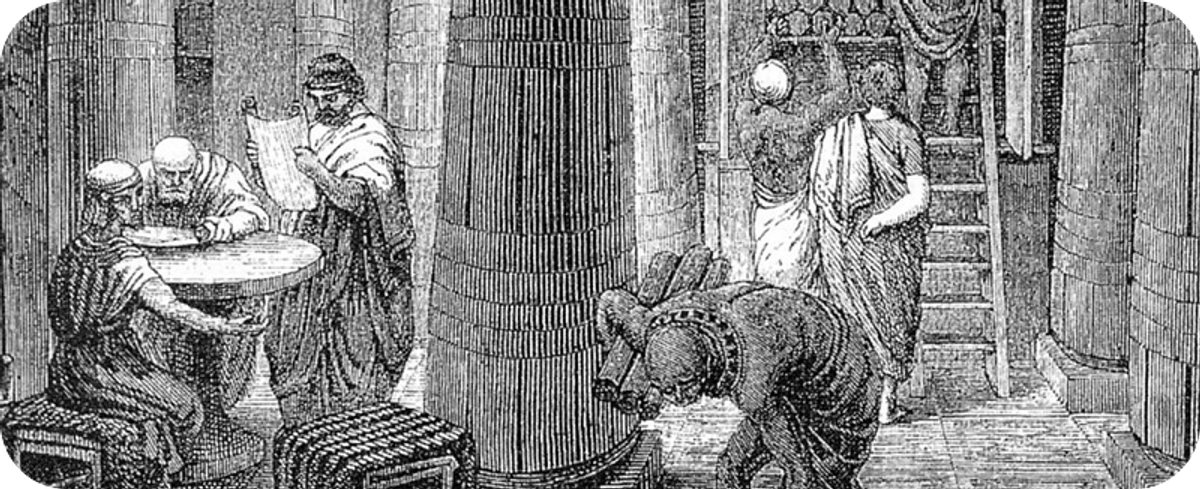
For years I kept an archive the way I’d learned was right: publicly, proudly, and without really reviewing it. Dozens of posts and articles, accumulated over years of writing. Tool roundups, tips for beginners, lists of things every designer should apparently know, each published with conviction, and I can remember the feeling of finishing them, the small certainty that this was how a body of work got built — post by post, list by list, a steady proof of presence within the discipline.
Then, earlier this year, I sat down to migrate that archive to my own site, and for the first time in a long time I actually read it. Not skimmed it for typos, read it. And somewhere in the middle of yet another listicle about AI tools, written by a version of me who genuinely believed it was worth someone’s attention, I stopped migrating and started deleting. By the end, more than half of everything I had ever published was gone from my site. Not archived, not marked private for later reconsideration; gone.
What interests me about that afternoon isn’t the deletion itself; every writer prunes, and every designer retires old work, so on the surface this looks like nothing more than editing at scale. What interests me is that the person who wrote those posts could not have deleted them. He was not lazy, and he was not cynical; he was doing his honest best inside a complete and internally consistent idea of what good work was. From inside that idea, the archive was not fluff waiting to be cut, it was the work. If you had shown him the burning that was coming, he would not have recognised it as growth; he would have recognised it as vandalism, and truthfully would have been hurt to receive critique on that body of texts.
Which means the knowledge that made the cut possible did not exist anywhere in him at the time of writing, it could not be reached by trying harder, reading more, or iterating on the next post; no amount of refinement within his idea of the work would ever have produced the judgement that the idea itself was the problem. That judgement only became available to me on the far side of something I can only describe, without any mysticism intended, as a ‘death’. The writer of those posts is not an earlier draft of myself, someone I improved upon gradually until he faded out; he died, and someone who could see that work as something to burn began.
We tend to tell the story of creative growth as a slope: skill accumulating, taste sharpening, each year’s work an upgraded version of the last. I’m now instead convinced that the slope is the wrong shape entirely.
What I want to argue here is that a design and a designer, a creation and its creator, cannot be perfected at any point along their evolution, because the perfected form is not a point at all; it is a cycle of death and rebirth, seen whole — and each death, like mine in that archive, is only ever understood from the far side of it.
Reincarnation, not iteration
‘Iteration’, an integral element for Design, and one I have no critique of; iteration is the engine which drives forth progressive improvement from one version to the next, and is integral to humanity’s development beyond design. Attempt one reveals a flaw, the flaw gives a vision into improvement, and the work grows — so much of our professional working image is based on this journey, through the maturity of the products we care for, and I don’t disagree with it, nor do I ask us to abandon it.
However, if you meditate on what iteration assumes, where version two must improve on version one, someone must stand outside both versions and judge the second as greater; for that judgement to hold meaning, the judge must stand still. Iteration presumes the continuous self, a set of values that hold stable during measurement, so that improvement is genuinely registered as such — we do not question whether the conversion was worth pursuing, we get better at pursuing it, and this is what makes iteration inherently productive; though, precisely what defines its limitation: it can refine anything except the self doing the refining.
What happened to the work in my archive of writings wasn’t iteration, and the proof of that is practical: I could not write those pieces again. Not that I would choose not to; I couldn’t. The posts weren’t badly made per se, and by the measure of the writer at that time, they held, and were competent enough — a more skilled version of that writer would have polished it and improved further. To create that work required the belief in a certain set of values and a container of knowledge about what those writings were for, and that believer no longer exists.
The form that existed didn’t degrade, nor improve, which is the purpose of iteration; it became ‘unmakeable’, which is entirely different. Version one of a design sits in the file, and given logic, it could ship; a reincarnated self cannot ship its previous work at any price, because the work is inherently inseparable from the self that created it.
That is the distinction that I want to make here: iteration is change within a known self; the same designer, the same values, a better result. Reincarnation, is the death of the self that created that work; not a revision, but a discontinuation, after which the old work is not improved upon but excommunicated from the self.
It’s simple to confuse the two externally, as both leave behind a trail of ‘versions’, the difference, though, becomes evident in whether the creator could, in principle, go back. An iterative designer can retrace their steps — a reincarnated one turns around and finds the path that led them here, razed, often finding something in their wake that can become difficult to rationalise or understand; the way we perceive our past work and past self, and question what led them there.
What impact this has for visibility, is that within iteration we can watch ourselves perform that act; it happens underneath a spotlight, with clarity imbued amongst changelogs and historical versioning, within a narration we can fully comprehend. Reincarnation doesn’t hold those artefacts, and it doesn’t allow for the review of the change, because the one who could both write and empathise with it, has died.
If the self that dies cannot see that death coming, and the self that follows is not present for that shift in paradigm, when exactly do we know of ‘Reincarnation’?
Full stop.
My intuitional reasoning for the change in my writing archive going unnoticed for such a long period, is less inattention, more that I was watching my own work, within a methodology typical for most: reflect, document the process, contemplate privately. Within this recipe, the ‘self-aware’ designer is supposed to catch that shifting, but I’d argue that with all the virtues tied into self awareness, there is a clear structural blind spot; it can only inspect the self that is currently inspecting. The tools that belong to reflection, emanate from the living cycle, built from its values, seeing with its eyes, and so they are excellent at measuring progress within the boundaries of an idea of the work, yet constitutionally incapable of seeing that the idea itself is dying. Asking the self to observe its own death, is akin to asking the eye to watch itself close.
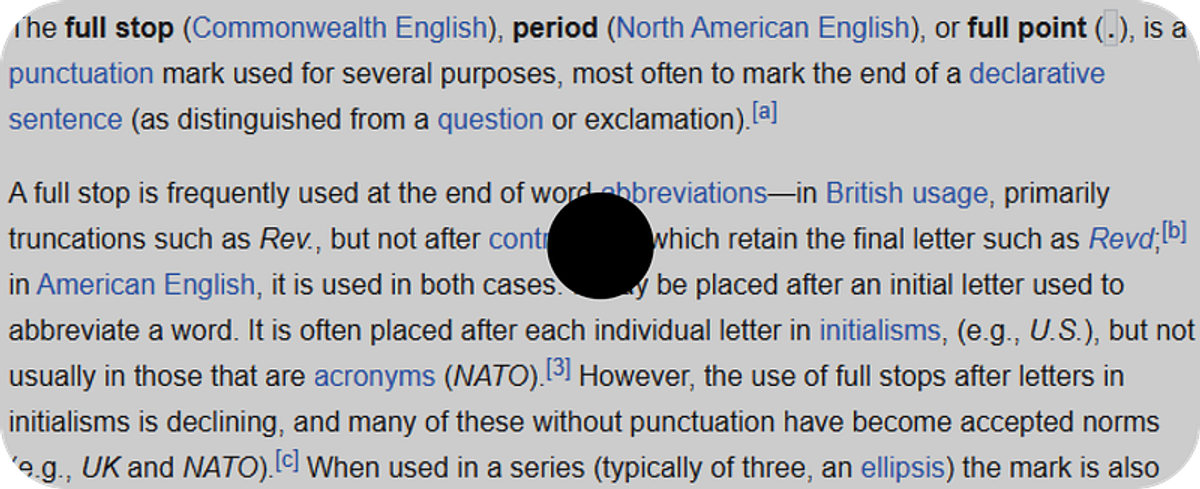
A sentence, whilst being written, could mean almost anything; every clause moulds the ones before it, and no word is definite in its meaning until the final word closes. The full stop, in this regard, is what makes the sentence readable, not because grammatically it’s proper, but because then, and only then, does each part of the whole take a settled place. I want to suggest that the exact same is true for the creative life: the unit of understanding is not the moment, the project, not the time, it’s the completed cycle — and a cycle, by its definition, is only complete once something within has ended. We cannot read a sentence we are still inside.
That’s why the culling of that archive taught me something that the act of writing it was entirely unable to, despite the writing taking years, and the deletion barely an afternoon; it wasn’t that the afternoon contained more information, a culmination of all the writings digested into a single moment, no, it was that it contained that very full stop. The whole archive became legible at once, the way a sentence does. What those posts had actually been for, what the person writing them had been building, and what all of it had been mistaken about; none of that knowledge existed at any point within the cycle. No version of this knowledge was available early, there was no warning sign I failed to take note of, no guidance to steer me down the right path; all because that next step, down a shrouded pathway, was cloaked in a form that only the next self could comprehend.
“Where am I in my development, is this my great work, have I arrived at my maximum” — not only are these simply hard to answer, they’re entirely unanswerable from where we stand today — whatever we are currently inside is, by its absolute nature, unread. The certainty that we are able to feel about our present form is not evidence of arrival, it’s the ordinary circumstance of an incomplete sentence.
And so, if certainty is what the interior of every cycle feels like, what is to be made of the moments when we feel most finished? I believe a tradition that existed long before formalised design holds an answer to this, in essence by inverting the value we place on expertise itself.
Narrowing of mastery
The settled ideology within design orients itself about certainty, the certainty that experience within the field affords. Early in our journey, we hedge bets and are activated by the will of those more senior, and as our experience develops, we instead commit and form that pathway; thousands of hours of doubt transform into sharp judgement, awarded a sense of ‘knowing’ from having learned. I have little concern or debate with that story, for the most part, but if you sit with what expertise actually accumulates — what it accumulates beyond that which is typically ledgered — another mote of dust appears: every solved problem retires a question we no longer think to interrogate, and every hard earned conviction about the way things should be, closes the doors to another. In this, skill grows by exclusion and neglect; the craftsman becomes faster precisely because they are no longer considering each possible move, and our internal experience of mastery, structurally, is a narrowing. What feels like a wind tunnel of clarity, is only so because the scenery around it is no longer observed.
Shunryu Suzuki, a teacher of the Zen principles, captured this insight within a single line: in the beginner’s mind, there are many possibilities, but in the expert’s mind, there are few. On an initial reading it sounds like a compliment to beginners, and I can commend that to an extent, a gentle corrective measure against arrogance. Read more plainly, however, and it becomes the description of a mechanism of learning: the expert’s mind does not simply hold fewer possibilities, it can no longer explore the others. The writer of my pre-archive articles was not short on reflection, he instead was short on possibility, and no measure of self reflection can multiply those possibilities from within a cycle that has already excluded them.
What this gives us, is an entirely alternate meaning for the sense of ‘completion’; if mastery is a narrowing, then what we read as arrival, that familiar and settled process, a recognisable style, a confidence in what is good and bad, is instead the corridor at its tightest point. Peak certainty becomes now, the moment when a cycle exhausts its own possibilities, placing itself instead of at the summit of a mountain, now at the end of a sentence. The feeling of finalisation is no longer evidence we’re done, it’s evidence that the self is. This parallels with what Dunning and Kruger observed in the incompetent, where confidence blooms precisely because the ability to perceive a limit is missing; the same holds an exact twin at the far end of a skill, where the mind that has excluded everything beyond its corridor, can no longer perceive even the walls of the corridor.
I’ll part ways with Suzuki’s typical interpretation here, wherein ‘Beginner’s mind’ is typically read as advice: remain open, hold expertise lightly, and practise toward possibility; I’ve argued so far in this essay, that the door doesn’t open that way. A self cannot cultivate its way out of its own exclusions, in the exact way the mountaineer could never see the mountain in the midst of their ascent. The possibilities do not simply ‘return’ to the expert, they return to whoever the expert becomes when the corridor collapses in on itself. Openness, in other words, is not a discipline available or accessible to the living cycle; it’s what rebirth offers, and demands payment for.
From art to canvas

Process is a trait I consider important; breaking things down into their parts, step by step, to appreciate them as the summation of an entire system — and this carries itself into my creative life, serving also as the first payment of ‘death’ I can point to. For the (near entire) life I’ve spent painting, I’ve considered the canvas the integral step where art becomes more than an idea, where its outline takes form. I bought canvases the same way I bought paint, as inert equipment so that the creative act could take place over it.
The antagonist to this methodology arrived at some point I can only find in hindsight: I had a calling to make a very large canvas, the type that isn’t found at Hobbycraft or Amazon — so I went to the hardware store. I bought wood, I bought a saw, and I bought canvas fabric, and then, I got to work. The results of that canvas, honestly, are imperfect, with corners that aren’t quite perfectly square, tied together by heavy duty nails to ensure their form stays as intended; all of this easy to assume as a pursuit of quality, into a new craft, but it wasn’t that at all. It wasn’t my skillset or standards changing, it was my sense of where the art began; where my art process was allowed to start, where the creative act takes place. That boundary had moved backwards, out of the paint into the wood itself; and even though that canvas, sewn with an off white, homemade gesso, sits without design or sketch, it’s one of my favourite pieces. I didn’t argue myself out of where this newfound process began, I simply noticed, one day, that I held something new, and something else had died.
To me, the thing is legible: I can read the moved boundary in it, the whole retired belief about where making begins, the way I can now read the deleted archive. To anybody else, it’s an empty canvas (and a slightly bad one at that), and there’s nothing I can do about that gap. I could explain everything I have just written to a visitor, and they would understand the account without seeing what I see, because it’s not the canvas carrying the knowledge; it’s the death. What that completed cycle teaches isn’t information transferable by description, but closer to sense, a sense that cannot simply be handed over.
I believe this to be the second property of reincarnation’s knowledge, alongside the reflection of the full stop; it, in essence, is non-transferable, exclusive to the person on the other side of the death. This also explains something that can typically look like a failure of both design writing, and design work itself: the discipline’s most senior voice and rationale can sound either banal or mystical when they try to impart their knowledge; the corridor’s collapse cannot be taught in advance. Every mentor’s hardest earned lesson cannot simply be handed down to the student, they must undergo the death themselves. This knowledge is not inherited from one another, it’s earned each and every time; perhaps this is why, long before formal design existed, the traditions that treated rebirth and reincarnation with such fervour stopped trying to explain it in propositions, and reached for symbols instead.
The wheel as it turns
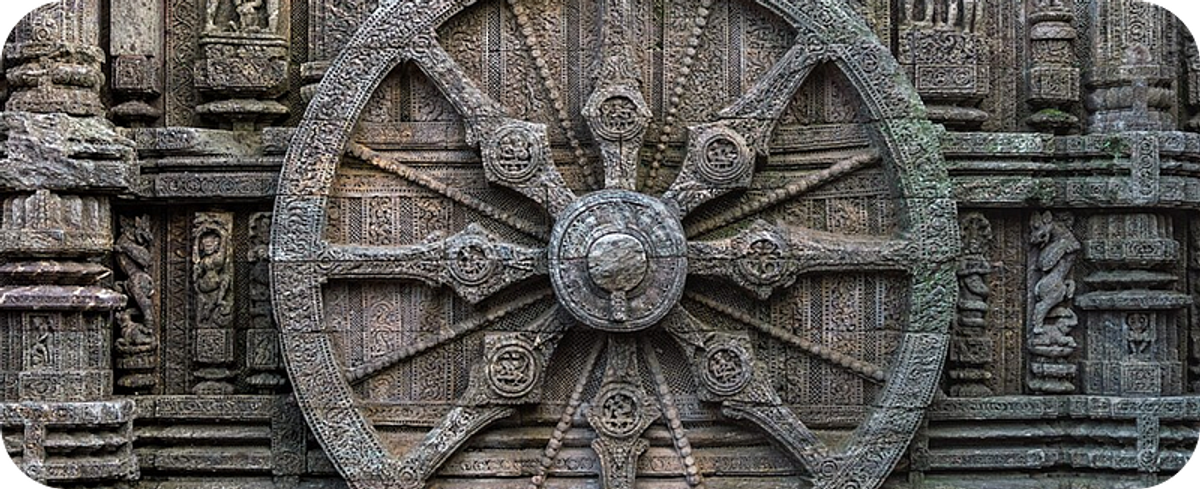
If not obvious from my last paragraph, none of this knowledge is new; the traditions that organised themselves around rebirth arrived here long before I did, and they found themselves at an insight that I’ve circled so far: propositions are the wrong container for this form of knowledge, for the knowledge that death teaches. Having established the lessons of reflection and non-transferable knowledge, I feel it apt to explore the understandings which the old traditions attempted to impart through depiction, over explanation. Symbols do not claim to transfer their knowledge, they exist in waiting for whoever has paid the price of comprehension; an endless web of potential understandings, as a mirror made by those who have carried that death.
Within Hinduism, destruction is given a face, and does something that many crafts reject: it gives her divinity. Kali is not the opposition to the created world, but part of its upkeep, destruction folded into the same cycle as making, with iconography precise in a way that internally unsettles. The garland of severed heads — ego, worn not as trophies, but liberation. A blade drenched in blood, having performed the severing of the latest ending in another hand — provision of divine knowledge, its blood dripping into a bowl that overflows. Within this divine construction, everything about the corridor and its collapse, is pronounced immediately, without words, with a claim that culture cannot metabolise: the force that ends our working selves deserves reverence, not management.
The Tarot, one of my favourite forms of internalised wisdom, compresses that same knowledge into a two card grammar, within The Tower; the experience of the collapse symbolised. Lightning strikes a structure built high and with pride, figures by its wayside falling without the choice to leap, depicts the demolition that arrives from outside the self’s planning. The Fool, the first card in the major arcana, walks out of that rubble; possessions reduced to a small bag, divine guidance in the form of a small white dog by their feet, one foot across the edge of the cliff, ready and willing to experience a new world. The sequence is important here, as traditionally no figure is depicted ‘renovating’ the tower; there is only the structure, its end, and the fool who begins once more. Within this, the entire essay is encapsulated: the corridor narrows, the full stop is felt, and the expert once again becomes the beginner.
What I find striking about these symbols, is the tense in which they exist. Kali’s garland already contains many heads taken, not just the most recent; The Tower is painted mid-collapse, not mid-construction; The Fool has already left the comfort of the city behind. These spiritual traditions conclude precisely what the canvas taught me: this knowledge has no form that’s forward facing, no functions of warning or guidance. They are not maps of the cyclical wheel of rebirth, they are what the wheel looks like to one who has already experienced it. This leaves me with one last question for this essay: if we are always either mid-cycle and blind to it, or post-cycle and grieving the collapse, where in all of this does the perfected form belong, that we’ve set out to discover?
Realisation

I opened this essay essentially questioning where perfection sits, and have attempted to rule out each of the hiding places throughout; not within the artefact, nor the accumulating self, nor the moment of arrival. Following these eliminations, I’m left with one final candidate: where we have been looking for a single point on the wheel, the answer was that it’s the wheel itself. The ideal form of a designer is not any self within the cycle, however refined it becomes; it’s the full cycle of death and rebirth, seen as a whole, whose deaths are not interruptions, and that which without its full stops, could make no sense of the sentences. Realisation was never release from the wheel, finally earned by getting the cycle right, it was the recognition that the wheel itself, turning, was the perfected thing, and that recognition changes nothing about that turning. We are not granted a final form, instead, we are occasionally and only backwardly, granted a glimpse of the shape we become.
If that’s to hold true of me, and inherently true even of this essay, then I would suppose it is of others — as within, so without. Somewhere within your craft as much as mine, is a certainty that feels like completion. A process, a style, a sense of good and bad; I cannot tell within the form of writing whether that certainty is judgement or narrowing, and by my argument, neither can you. Whilst a potentially difficult weight to carry, it also holds a mercy; if your process no longer works, if the creations that once felt like yours have now started to read like a stranger’s, if you stand in front of a portfolio of work you can no longer quite understand having built, nothing is failing. This is the mid-sentence state, close to the full stop. Not a failure, rather the mechanism. I only ask that we stop mistaking collapse as loss of investment, and as evidence the wheel is broken
An honest coda

This essay could end here, but honesty requires a coda, as I am aware the wheel has not finished within me, and I have proof. In my recent working life, something has died that I can name and feel, but not point to: that designer who led with requirements, outlines, others’ comfort and opinion, and deemed that to be ‘professionalism’; yet, I’ve felt that certainty go, the same way that I felt the archive go, and the same way I felt the shop-bought canvas go. Here, I must practise what I have spent this essay preaching: I do not know what that death has made me. The cycle is too warm, the sentence holds no full stop, and by my own knowledge, I am the wrong person, standing at the wrong moment, to impart what I’ve learned from it, to tell you how to grow from it. Had I been that earlier writer, I may have tried to force a lesson here; however, letting this death lie unread, and finding that this feels less like ignorance, and more like accuracy, may be the only evidence I can offer that something, somewhere on the wheel, has turned.
“Not only can one be reborn, one may be twenty or forty or even seventy years old in the new body though only two years after death.” — Sri Ramana Maharshi
References
Primary philosophical and spiritual sources:
Shunryu Suzuki — Zen Mind, Beginner’s Mind
David Chadwick — Zen Mind, Beginner’s Mind analysis
Sri Ramana Maharshi — Talks with Sri Ramana Maharshi, Talk 129 (1936)
The cycle:
Britannica — Karma, samsara and moksha
Psychological research:
Justin Kruger and David Dunning — Unskilled and Unaware of It (1999)
Kruger and Dunning — Unskilled and Unaware, But Why? A Reply to Kruger and Mueller (2002)
Symbolic and iconographic sources:
Arthur Edward Waite — The Pictorial Key to the Tarot (1911)
Tarot.com — Pamela Colman Smith, the artist behind the deck
Kali — iconography of the Hindu goddess
Objects and works cited:
Zacharia Curtis — The writing archive
Zacharia Curtis — Hand-stretched canvas, untitled


