


Living within the ‘rush’
Initially, I noticed this as an absence, rather than a symptom; rushing through chores on an evening with no plan, moving towards a destination on the map as if the walk there is a task, reading a page over and over without anything of value being left behind — all wanting occupation and efficiency over experience. None of these came from a particular fatigue or boredom, more so muscle memory, or perhaps I’d picked up an unwanted hitchhiker somewhere; my private life was starting to be, albeit quietly, rebuilt in the shape of the work I do for a living.
What I wanted, in the hours that belonged to me, was somewhere without an objective; and so, in the past few months, that desire became four small worlds in the shape of digital experiences, each without a template for where to go or where to arrive, albeit at a juvenile level towards where I wanted to take this idea. No menus between you and the noise, searches that answer questions with webs instead of lists, books that hand you poetry rather than optionality; no brief, and no distinct finish line.
In truth, I wasn’t setting out to prove anything with them, it was more of an intuitive ‘play’ I was engaging with whilst building them, and building them like I do with my typical work felt like it was inscribing a subtle loss. In hindsight, I can see clearly that the shape in which these were taking, were trying to clarify the absence of something else within modern digital experiences — Why do the products we live inside, day after day, never ask us to wander?
What we’ve settled for

What’s been built today, exists with legibility as the pillar - Products want to be understood in the first few seconds, and with every path desiring immediate resolution, every screen demanding perfect situational awareness within the journey and where you’ll arrive next on interaction; in this world, ambiguity is a failure state, a mode to be tested out of existence before launching.
In “Filterworld”, Kyle Chayka defines a phenomenon, where algorithmic recommendations flatten our culture through homogenisation, wherein the least ambiguous, least disruptive, and often least meaningful pieces of culture win, thus promoting a system where the most legible product wins - The machine only surfaces what it can first sort, so sortability becomes this essential trait; clarity isn’t what we’re simply shown, it’s in everything we build, like a bug in the code that has become a required feature. Whilst Chayka attempts to explore a resolution here, he’s unfortunately so successful in relating the phenomenon back to modern life, that any resolution feels like a homemade salve on an open wound.
Down the Rabbit Hole
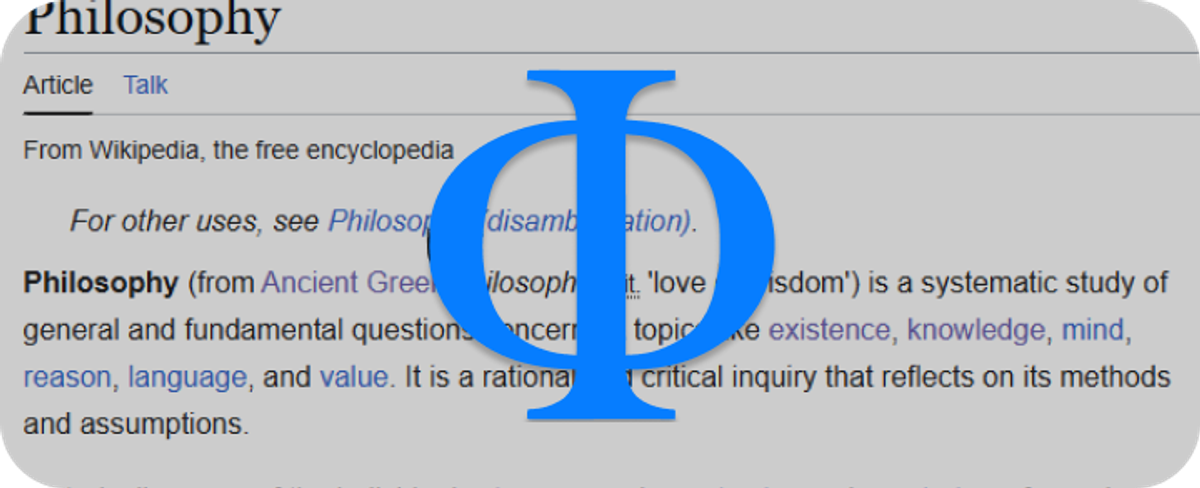
The strange thing is, though, that clarity and discovery aren’t actually opposites, they’re just treated that way - Taking Wikipedia as an example: follow enough blue links and you can lose an afternoon, every subject famously leading only a few clicks away from ‘Philosophy’, with content between built genuinely for that wandering. The interface never lets us feel that, instead situating itself within an architecture you can see the exact edges of, every link announcing exactly where it will take you prior to clicking; This leaves the wandering happening in spite of the design, rather than being embedded within it. It’s the difference between becoming lost in an unfamiliar city, or reading the street signs on every corner instead; Worse yet, having every signpost shouted out loud, even if you weren’t interested. Both involve every road and both offer discovery, yet one demands a destination and conclusion, the other leaves you to wander.
Those blue hyperlinks are the perfect allegory for entering a dark, unknown tunnel with the promise of new information: Imagine slowly being surrounded by that darkness as you emerge into into a space where everything is shaped by the visual relevance of the current topic you’re settling into, a great set of marbled gateways standing at the apex of an ancient Grecian agora, the sun glimmering down and a temperate climate encapsulating you, as you learn about the social life of the free-born citizens, view the works of artisans of the 10th-4th century BC, and come to understand the etymology and language associated with this gathering space, before heading through to immerse yourself in the next lesson the experience has to offer.
The Plague of Optimisation
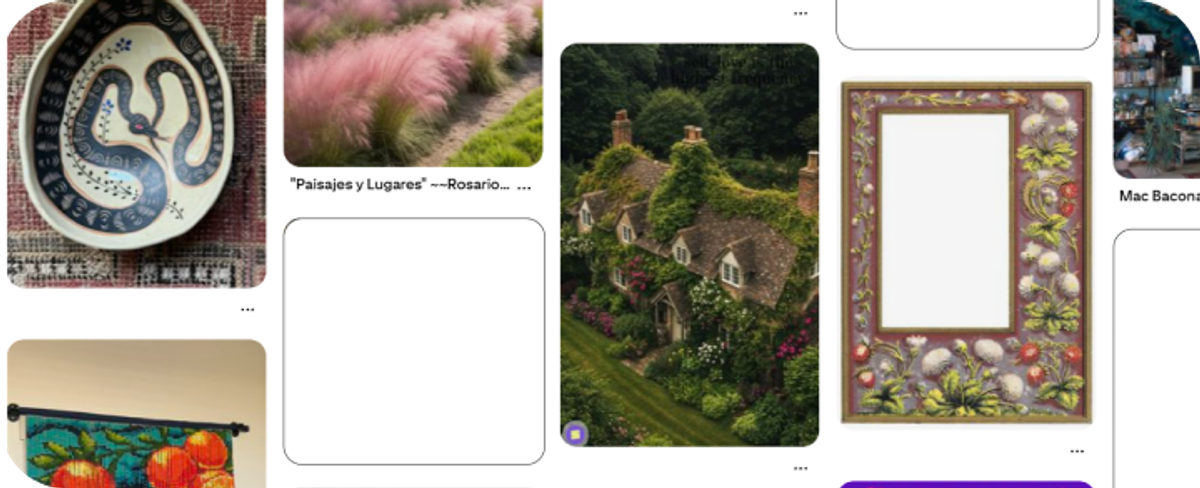
As I mourn what the internet could have been, whilst staying cautiously optimistic of what it should become, I’m reminded of Pinterest; an example where I’ve felt the tangible difference. I used an ad blocker, I have for years. As an artifact of that behaviour, I’ve watched the empty, white spaces where adverts would sit slowly grow across the interface like a plague, whilst the platform gears and reforms itself toward conversion, and less towards genuine discovery: You’ll have whatever the algorithm decides you will.
I used, and still do use, pinterest as inspiration for my own art, and in this regard the loss of discovery is felt moreso: Instead of the collision between classical masters, playful contemporary pieces and the odd tattoo flash within the same scroll, it’s more the same thing tuned tighter and tighter, until the feed constricts into this obedient flow.
Products we built for browsing and discovery have had their value extracted, and a virus placed within instead; one that demands profit and growth.
As critical as I am here, none of this is about bad, lazy, nor dishonest design. It’s a thread where from a discipline that decided, somewhere along its growth from infancy (and largely without noticing), that legibility and efficiency was worth more than what the legibility was supposed to serve. After that decision was made, wandering stopped feeling like a feature, and started looking like failure.
The Hustle
I don’t believe this deviation was accidental, and I want to properly ascribe where that instinct to eliminate it came from, because it isn’t culturally neutral. This decision comes from a specific anxiety, one where the people building for this efficiency have no reason to notice it; It simply isn’t valuable, and efficiency is common sense.
Whilst walking through old street in the heart of London, on my way to the office, I’m constantly arrested by people shoving themselves into crammed northern line trains when another is only a minute away, skipping across red lights in a flurry of traffic when the green signal comes only a second later, all inhabiting the culture of “Hustle” into their daily existence.
When Products Become Religion
Carolyn Chen’s foray into Silicon Valley culture exposed this through a unique angle, wherein work culture has become something closer to a religion than industry: work supplies meaning, belonging, and purpose in a way that previously was the role of faith, and this conviction that a product might be genuinely revolutionary, has curdled at scale into a fanaticism more than a strategy. This fanaticism, I believe to be one of the roots of this problem as a whole, as efficiency becomes more than a business metric, instead it becomes a virtue, a virtue which is exported without being flagged as belief, a virtue that is felt, and realised, by users of the platform en masse, every day, regardless of whether they had been initially indoctrinated into that core belief system that produced it. The people designing the products are living within the belief system that creates it, bleeding that culture into their creation.
Chen traced the hardening of this effect since 2023, specifically within a renewed hyper-focus on doing more with less, operating beyond the roadmap, and where singular employees equal the headcount of several, and this is felt in the structure known as “996” - 9am to 9pm, 6 days a week. This structure can be worn as a badge, but also enforced through the hiring process for those who will even join the team, I hesitate to overstate the obvious in how such a relentless framework would translate to design, but it’s evident that it would be strange if what was built it these spaces reflected anything except that framework.
Self-assimilation of Exploitation

Byung-Chul Han names this ‘feature’ of our lives a proper name: auto-exploitation, wherein we shift from a world where control was traditionally imposed internally, to one where the imperative to perform has been internalised so completely that self-exploitation now presents itself as freedom, ambition, and drive; there is no longer a need in the top rungs of disciplines to enforce the hustle, because everybody inside has already agreed to enforce it upon themselves.
This point is where it’s no longer about silicon valley specifically, but about design directly: designers operating under this new rule of auto-exploitation aren’t enforcing this mode of efficiency on their users out of malintent, there simply exists no working model of a valuable experience that doesn’t orient around efficiency, because they haven’t been permitted to hold one. Han draws a further distinction that I feel of import to my point, between deep attention and hyperattention, a mode defined by constant, low tolerance task switching with no patience for the idleness that creative thought requires to bloom; once you see this hyperattention as a working condition rather than personality trait, and how deeply woven our culture and society has become with it, the conclusion is evident: Hyper-attentive designers build hyper-attentive experiences, further weaving this behavioural pattern into its users. The design reproduces the psychology of its creators, whether either party recognises it or not.
What started as an anxiety within a specific frame, has been decontextualised so thoroughly that now it arrives as ‘good taste’, or ‘best practice’, what a well-designed product is supposed to look and feel like. Those values are the same that now present themselves as the future of optimisation, gaze tracking, ambient audio, and behavioural data that nobody really remembers signing over, not because they’re nefarious, simply because a culture that can only recognise its value through measured optimisation has no other language left to speak in.
“Trauma decontextualised in a person can look like personality, trauma decontextualised in a family can look like family traits, trauma decontextualised in a people can look like culture.” - Resmaa Menakem
It wasn’t always like this
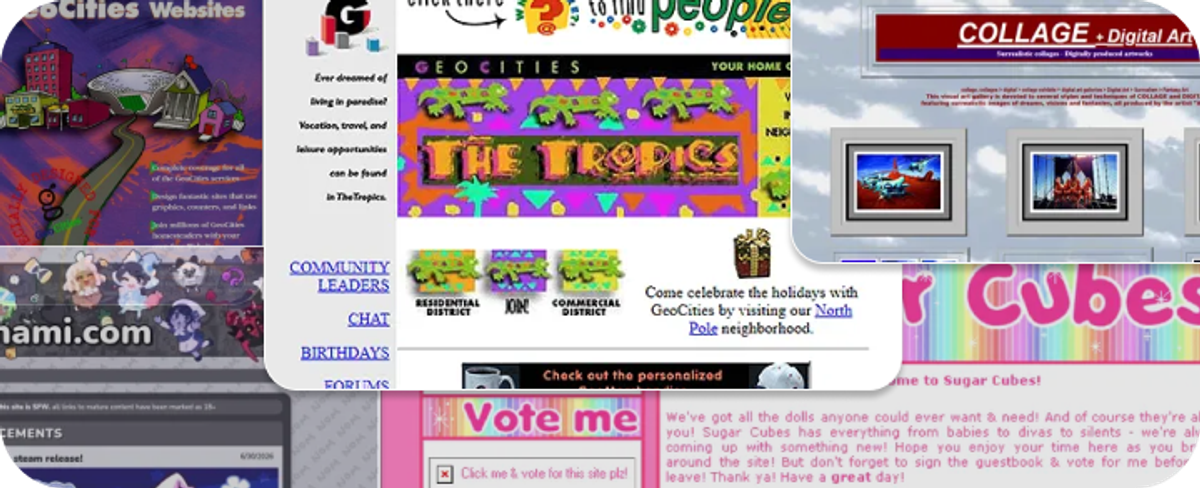
It’s far too easy to conclude that the reason this has happened is because of ‘progress’, that design has matured beyond its wandering phase the way anything should mature out of a juvenile clumsiness, and that there’s no going back; But the early web wasn’t clumsy in a way that needed fixing, it was a frontier for the “Wild West”: GeoCities pages built by hand, sometimes badly, always proudly, each feeling like a small unrepeatable act of a person deciding what a personal page, unique to their own form of expression, should look like; no template telling them what to do, no algorithm showing which did best.
These kind of experiences, before social media and centralised net dominated, were focused on a homespun aesthetic where each experience was like a giant treasure hunt - Newgrounds handed over a wall of flash experiments to its users with no algorithm curating which you might like - A title, a thumbnail, and curiosity was the only given; No funnel, just rooms with the doors left open.
Classical Renaissance

My point here isn’t nostalgia, that isn’t the container for this change; what I’ve been orienting around is better described by the “You think you do, but you don’t” speech that framed the industry’s poor assumption that nostalgia, rather than the appetite for inhabitation, drove the return to classical forms of experience. Gaming has become a foundational scene for this philosophy, with a resurgence for the ‘Classic’ versions to their modern counterparts, all with more popularity.
Classic versions before the optimised world and progression, before the hand holding and algorithms deciding what to do next, before the glowing map and shiny buttons, it was all discovery; you find what’s next by wandering somewhere you hadn’t been before, and noticing something worth investing time into. Objectively, this is a harder experience and by todays standards, ‘bad design’, but for the players who originally inhabited these worlds and drove the growth of these companies, it was exactly what made the world feel wide and worth living in. Efficiency made the web, and everything that once connected us, feel small, in the worst possible way.
This desire never went entirely away, either, it just went underground, with the appetite still present. ‘Webcore’ and ‘Anemoia’ now exist as design and aesthetic categories precisely because people are grieving a version of the internet they can point to, screenshot, and recreate the mood of; this means our culture already knows exactly what it lost, and has started building little shrines in the decentralised web in praise of it, and whilst this isn’t proof that the old web is returning, its proof that the current state we’re living in wasn’t ultimately inevitable.
Realising discovery
If the current state of our digital environment was never inevitable, then we’re left with the obvious question of what the utopian alternative looks like when built with purpose, rather than stumbled into.
Play as Experience
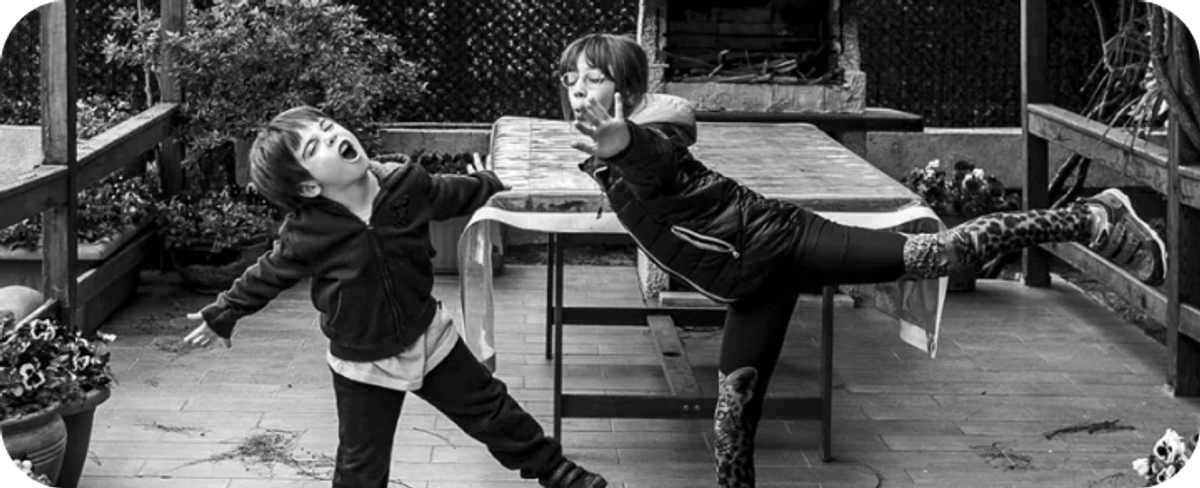
Johan Huizinga explores this idea in Homo Ludens, and whilst nearly a century old now, the idea still holds: play is a free and meaningful activity, carried out for its own sake, cordoned off from the demands of practical life while still bound by rules that hold absolutely within it. What holds the most here, is that it exists for its own sake - no ulterior motive, no extraction from the act in order to justify its existence.
Within this argument there’s an additional point, wherein “Play to order, is no longer play: it could at best be but a forcible imitation of it”. This stems from Huizinga’s statement that all play is a voluntary act, and directly critiques the gamified experience that attempts to graft playfulness into efficiency-driven design, whilst keeping the goal of efficiency intact; You can bolt on streaks and badges, but you can’t conjure play just by inviting it to the guest list.
Dewey helps create distinction here into why digital experiences don’t have the shape to hold play, describing a difference between merely experiencing something and having an experience; It isn’t about intensity or fullness, it’s structure. Dewey defines the ordinary task as scattered: interrupted by other tasks, resumed later without memory of where it was left, finished without a bookmark to that completion; an experience, however, is different in kind, not degree: It has a beginning that sets the terms for what follows, a center that develops rather than continuing, and an ending that concludes the story rather than simply stopping - Think of clearing notifications versus reading a short novel in a single sitting, both complete, but only one closes.
Completeness in this regard isn’t decoration, instead it’s what defines an experience at all, rather than an event happening to you. This loss isn’t a minor aesthetic complaint, it’s a collapse between art and everyday experience, leaving the fullness of everyday life fenced off for spaces only museums or galleries can contain.
During a trip to Tokyo, I was recommended to see teamLab Planets, a live art installation which embroils experience into art - The space is the gallery, rather than a space housing artworks, where you could find yourself surrounded by endless fractal mass of flowers, all floating in a way that I could still wander through the space, encounter others within the same experience, and form a sense of wholeness; that idea is exactly Dewey’s point, where there becomes no correct route through it, no objective, the piece simply completes itself through your immersed movement inside it - There is no replication of experience for two people to experience the same creation.
That difference is felt without the requirement for explicit language, existing between the spaces of action that leaves something behind once finished - Further, this form of experience is differentiated, though difficult to name, between the rare kind of moment that doesn’t produce anything at all, but alters possibilities after the fact simply due to having taken place. Most of what we call productivity in modernity collapses into a singular category, as though repetition, permanence, and authenticity are crude variations of getting something done, or, efficiency.
Trinity of Experience
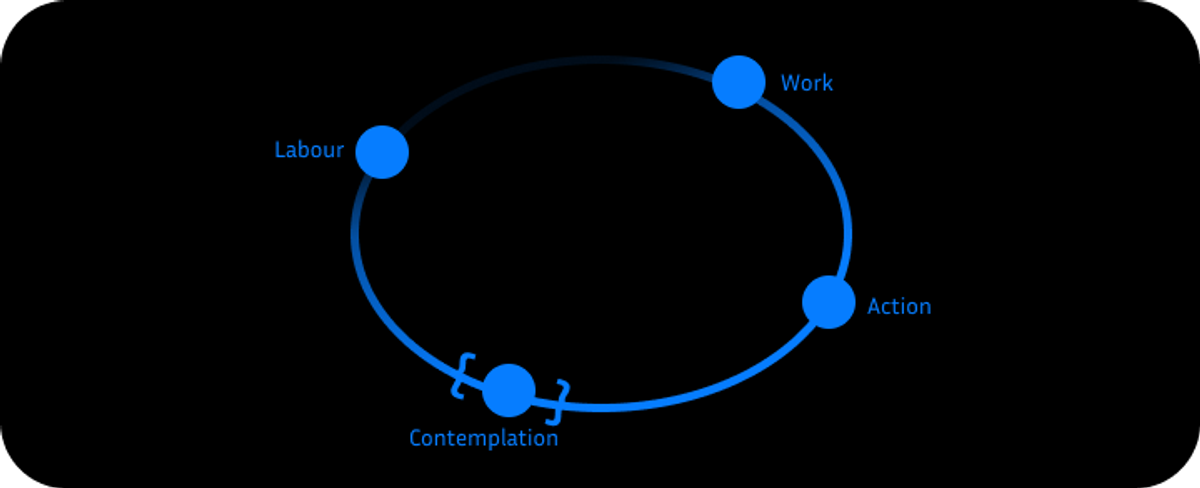
Hannah Arendt gives this distinction structure, arriving not at abstract philosophy, but a diagnosis of what has been systematically erased. Arendt separates tasks into a trinity, called the Vita Activa: ‘Labour’, which is cyclical and repetitive, leaving nothing behind; tied to biological necessity, the effort behind labour is consumed as it is spent. ‘Work’, which creates durability, enabling permanence; if labour is to consume, work is to create beyond the basic cyclical needs to create a shared human reality. Lastly, ‘Action’, which represents the height of the Vita Activa, in that it represents initiations and new beginnings through the individual expression of identity amongst communities. The concern however, was that these three distinct bodies were being flattened, and culture was losing the ability to distinguish between the three registers entirely, defaulting to treating human experience to labour.
That flattening is exactly what most digital experiences today perform by design: Open, complete, reset, repeat; a structure that guarantees nothing is carried forward, only cycled through - Arendtian labour digitised. Even the culture moving across these platforms undergoes the same compression - material that originates as someone’s work, occasionally someone’s action, arrives already reduced to something consumable in seconds, absorbed into the labour cycle regardless of which register it began in
Arendt held these parts of the trinity as distinct forms, or notably, completely parallel in her exploration of the ‘Vita Contemplativa’, the contemplative state, however I’d extend that belief: Action is what makes contemplation possible in the first place, and contemplation is what allows labour to be survived rather than endured - instead of three separate tracks, the Vita Activa and Vita Contemplativa form a loop, where the absence of one collapses the others back into primal repetition.
“it depends upon labor to produce whatever is necessary to keep the human organism alive, it depends upon work to create whatever is needed to house the human body, and it needs action in order to organize the living together of many human beings in such a way that peace, the condition for the quiet of contemplation is assured. ” Amor Mundi - Explorations in the Faith and Thought of Hannah Arendt.
On The Path to Novelty
The appetite for experiences like these exists, evidenced not only by growing critique of the state of the centralised web, but in products that are attempting to emulate this philosophy - Spotify Daylist, although a compromised version, is one exploration into this: a playlist that updates throughout the day, claiming to be discovery led listening. This is a real attempt from a major platform, but it can never be a true discovery as the surprise is already decided by everything you’ve told the algorithm before. No genuine ambiguity, instead a curated product dressed as one.
Are.na gets closer, with its clearest decision being almost entirely invisible via replacing the like button with a connect button, an engineered piece of friction that asks the user whether something actually belongs in a collection rather than if it’s something to like, forget, and repeat, instead creating a moment of real judgement - No ultimate destination, simply a sinking into the browsing experience. Lastly, Neocities, the proof that this isn’t a niche desire in the slightest - over a million hand built sites and eleven million visits monthly, entirely outside the algorithmic and centralised economy - meaning millions are choosing to not only create, but also inhabit exactly the kind of un-optimised space that we’ve spent so long smoothing down into apathy.
Play as the next currency
The idea of wandering within the digital experience is something that throughout this article, I’ve pivoted around; The essence of play belonging within that wandering a core pedagogy. Ultimately, everything circles back to the premise that the field of design, particularly within our products, has left unquestioned, yet continually refined: Reduce friction, get people to a destination faster, remove whatever obstacle is between the person and the thing.
Decades of design thinking have distilled this technique, mostly without interrogating the goal itself - The legibility, the labour loop, the extraction of the wandering, all of these are simply the unexamined goal being pursued with increasing competence and hunger.
In Search of the Wander
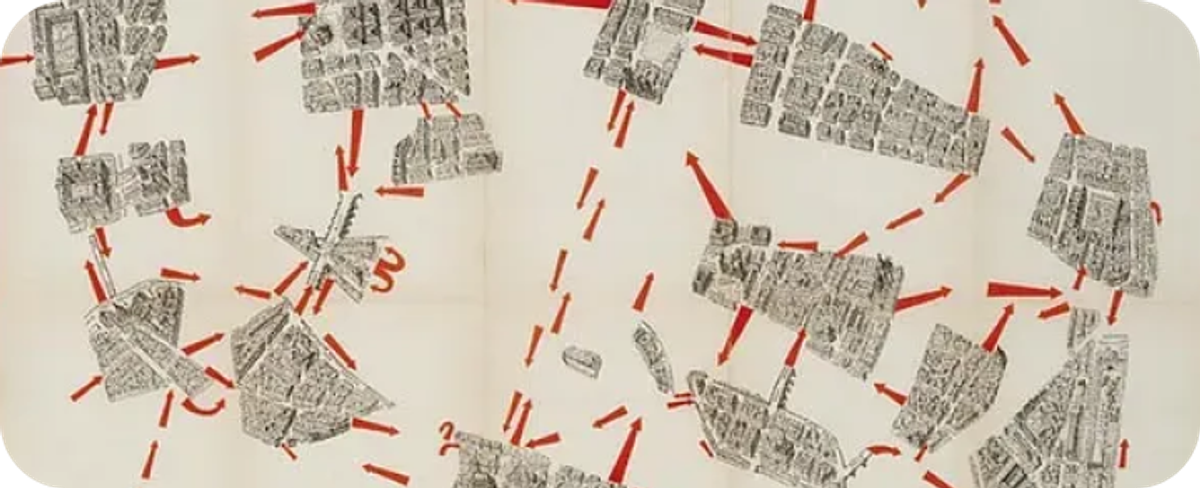
‘The Dérive’, was coined by the Situationists as an alternative; Less a method, more a refusal: drifting throughout a city with no destination laid in advance, allowing the terrain itself to suggest movement, rather than a plan. Debord framed this experience as a way of encountering the everyday as an adventure, rather than as a passive backdrop to function through, declared as a movement to revolutionise everyday life beyond the spectacle of labour - this would transform encounters from the rational, to play. This wasn’t aimlessness, nor poorly directed whim, the aim was organic experience in surrender to intrinsic laws of space, and of nature, where the space drew you in; It prevailed as critique of urbanism under capitalism - In similarity to how our digital worlds have altered hideously away from this drift - how could structures not resonate the very same essence of capitalism which created them?
Walter Benjamin’s idea of ‘aura’ belongs here as well as it explains something I’ve gestured at throughout this piece: why the loss feels like a loss. Aura, for Benjamin, was what a work possessed by being irreproducibly present in one time and place; reproduction doesn’t damage the work, it dissolves the quality that made the encounter with it unique. Today, we see standardised, template-driven design within the digital world, which has undergone the exact process in which a work loses its authenticity - the aura of the encounter has been reproduced out of existence, instead of each visit being genuinely different to the last.
Undoing Flattening

It’s tempting to conclude here, that digital experience is incapable of holding what a city, a conversation, or a genuine encounter can - that software is aura-proof by its very nature, infinitely reproducible at the code level regardless of what the interface does on top. I believe that to be incorrect. The theory of ‘aura’ was not as much about the object resisting duplication, instead it presents itself more so as the unrepeatable meeting between a person and a moment; the painting can be printed a thousand times, but nobody stands in front of the print the way the first viewer stood in front of the original. In this way, two people can follow a chain of Wikipedia links starting from the same article, and arrive somewhere entirely different, having absorbed completely novel information to that journey: one ending in political science, another in illustration, by way of children’s television. Whilst yes, the underlying content is infinitely replicable, the path each has walked is not; that’s aura, held within a medium everyone is assuming had already lost the capacity for it.
What has actually happened is narrower than digital design being unable to hold this concept, and if we return to the idea of template-driven design, we see that the unrepeatable path has been systematically culled on purpose, until each visit resembles the last, as well as every other adjacent product; this isn’t a property of the medium, it’s choice. Similarly is the case for wandering, or as the situationists called ‘drifting’; the refusal to plan a route in advance, allowing the terrain to guide instead - the reason the digital world lacks this is not because it does not have terrain, it’s that nothing has been built to allow the terrain to resist a plan. That resistance can be designed back in, it simply hasn’t because it looks to be the exact type of friction the entire discipline has spent decades razing.
This act is precisely what makes discovery valuable now, in a way that it wasn’t a decade ago, and will continue to develop as such - not sentimentally valuable, but structurally valuable, because scarcity creates value, and genuine unrepeatable experience has been left as the scarcest puzzle piece in the digital experience.
Designers should not be decorating products with play, instead, the foundations of what modern design considers correct ought to be burned to ashes, removing the pillars of further refinement from beneath them; those who do the burning shall be returning something people have been methodically starved of, and most have become unable to even notice it missing.
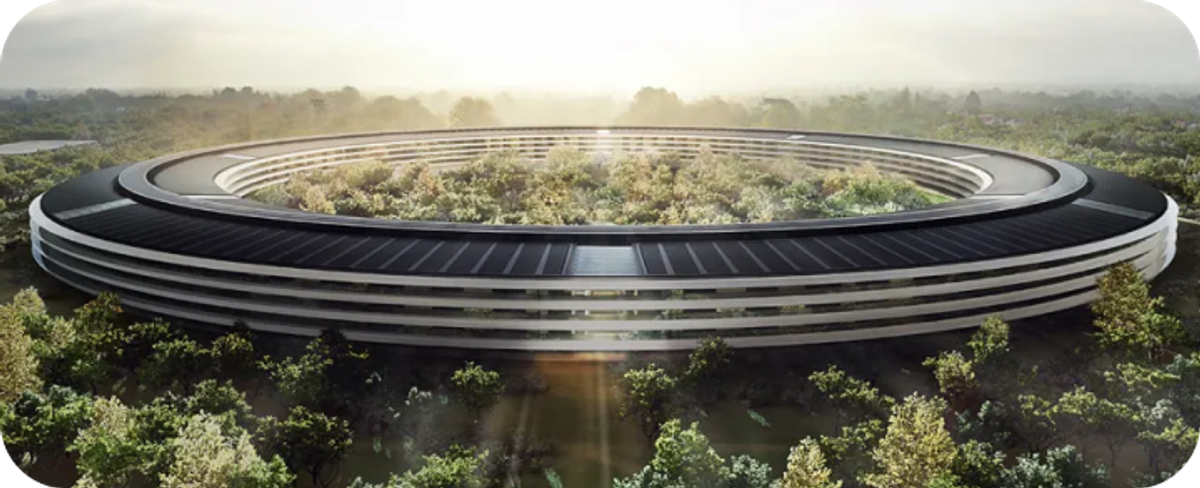
Returning to the architecture we began in, the Agora wasn’t a marketplace built with the purpose to convert, it was unstructured public space - the thought that emerged from it was never planned into its being, it arose from people occupying open ground without an assigned task, without a known destination, and without rush.
The only place to end this is with a question: When did you last wander somewhere with no plan and no destination in advance - A city, a market, a conversation, an idea that led you rather than you leading it? And, when was the last time you felt that way inside something designed for you to use, inside a digital experience?
“We did not search for the formula to overthrow the world in the books – but by wandering. It was a day-length drifting, where nothing was ever like the day before, and that would never end.” - Guy Debord, Theory of the Derive
References
Primary Philosophical Sources:
Kyle Chayka - Filterworld (2024)
Carolyn Chen - Work, Pray, Code (2022)
Carolyn Chen - Understanding “996”
Byung-Chul Han - The Burnout Society (2015)
Resmaa Menakem - On Trauma & Healing
Johan Huizinga - Homo Ludens (1938)
Gamestudies - Analysis of Homo Ludens Play
John Dewey - Dewey’s Aesthetics
John Dewey - Art as Experience Analysis
Wikipedia - Definining Art as Experience
Hannah Arendt - The Human Condition
Amor Mundi - Analysis of Labour, Work, Action
Journal of Ethics - Psychogeography as Embodied Connection to Place
City University of New York - The Notion of Aura and Media
Guy Debord - Theory of the Dérive
Cultural References:
Wikipedia - Wikipedia philosophy phenomenon
Emma Madden - Internet Nostalgia
Blizzard - Ignoring Customer Demand
Aesthetics - Defining Webcore
Dictionary of Obscure Sorrows - Defining Anemoia
Wikipedia - Situationist International
Products & Places:
Zacharia Curtis - Side Projects
Pinterest - Ad platform objectives
teamLabs Tokyo - Planets
Spotify - Daylist
Are.na - The Connecting Platform
Wikipedia - About Neocities
Digitrendz - Exploration of the Indie Web


