

Language works on people. Not only through the explicit content of what is said - the arguments, the information, the instructions - but through the associative networks it activates, the patterns it primes, the conceptual territory it makes temporarily more available to the mind.
This happens automatically, below the threshold of conscious attention, and it has been well-documented in decades of cognitive psychology research. Understanding it is not an invitation to manipulation; it is an invitation to design - and to write - with a clearer view of how words actually function.
Do as I say...
Consider the following sentence, then answer the question that follows without thinking: luck is a huge part of our lives; it would be a deadly sin to assume otherwise - after all, sometimes life is just a slot machine. Now, without thinking, pick a number between one and ten.
If the number was seven, you are in good company. Most people arrive at seven in this exercise, not because seven is objectively the most random-feeling number but because the sentence has quietly activated a network of associations that includes dice, lotteries, jackpots, and seven as a culturally established emblem of luck.
The association is not coincidental; it is the mechanism at work.
Schemas

The underlying cognitive structure here is what psychologists call a schema: an organised cluster of associated concepts, linked by meaning, context, and repeated co-occurrence. When we think of luck, the schema for luck contains: dice, seven, slot machines, fortune, risk, fate.
When we think of danger, the schema activates red, sharp edges, warning signals, speed. These networks are not chosen consciously; they are assembled over a lifetime of experience and they operate as the background architecture of thought.
What makes schemas relevant to design is that they are always active, always running, and highly susceptible to influence through exposure. A word, an image, a colour, a typeface: each of these can activate a schema, shifting the user's perceptual context in ways that are difficult to notice and difficult to resist.
Priming

The activation of a schema through prior exposure is called priming; the sentence above primed your number choice by activating the luck schema and making seven temporarily more available to conscious selection. The same mechanism operates in interfaces, in emails, in product copy - wherever language or visual elements prime a conceptual frame that then shapes how subsequent content is processed.
One fantastic example of Priming is in Fitzsimons, Chartrand & Fitzsimons 2008 study of 'Automatic Effects of Brand Exposure on Motivated Behaviour: How Apple Makes You “Think Different”. The idea behind this study was that simple exposure to certain logos, even incredibly brief flashes barely acknowledged by the conscious mind, can completely change our behaviours and thought processes. In this study, flashing a logo of Apple had the interesting effect of aiding creativity in those exposed, whilst those shown the IBM logo unusually did not experience this effect.
Spreading activation
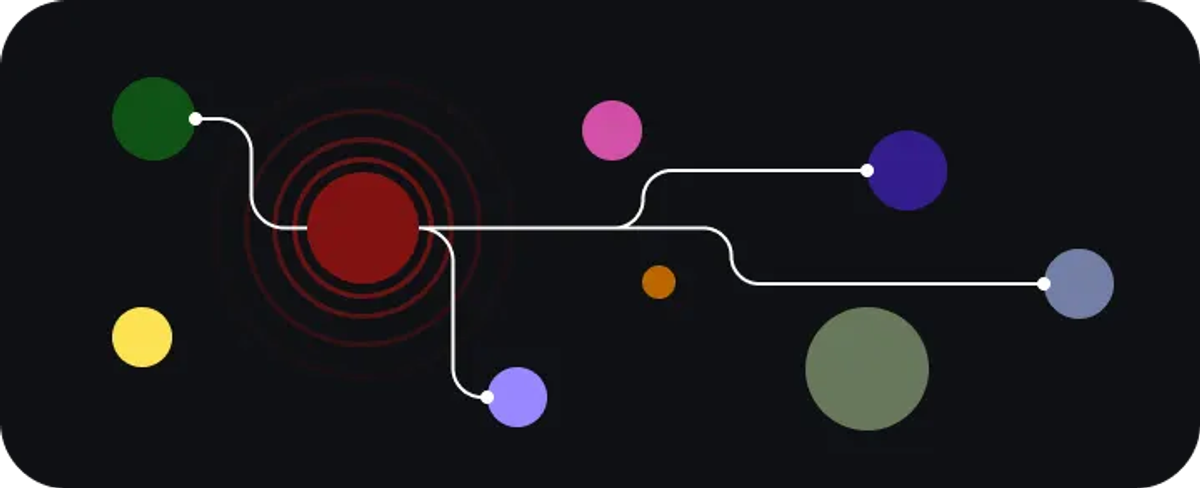
The reason priming works as powerfully as it does is rooted in the architecture of memory itself. Cognitive networks are structured not as collections of isolated facts but as webs of association in which concepts are nodes and the connections between them vary in strength.
When one node is activated - by a word, an image, an experience - the activation spreads outward along the connections, making related concepts more readily available. The stronger the connection, the more activation flows; the more nodes are activated, the richer the primed context becomes.
This is why effective UX writing cannot be reduced to clarity alone. Clear copy that activates the wrong schema - one that primes distrust, confusion, or the wrong kind of expectation - can undermine everything else the design is trying to do.
The words we choose do not only convey information; they set the stage for how all subsequent information will be received. Understanding that is, perhaps, the most useful thing a designer can know about how language actually works.


